
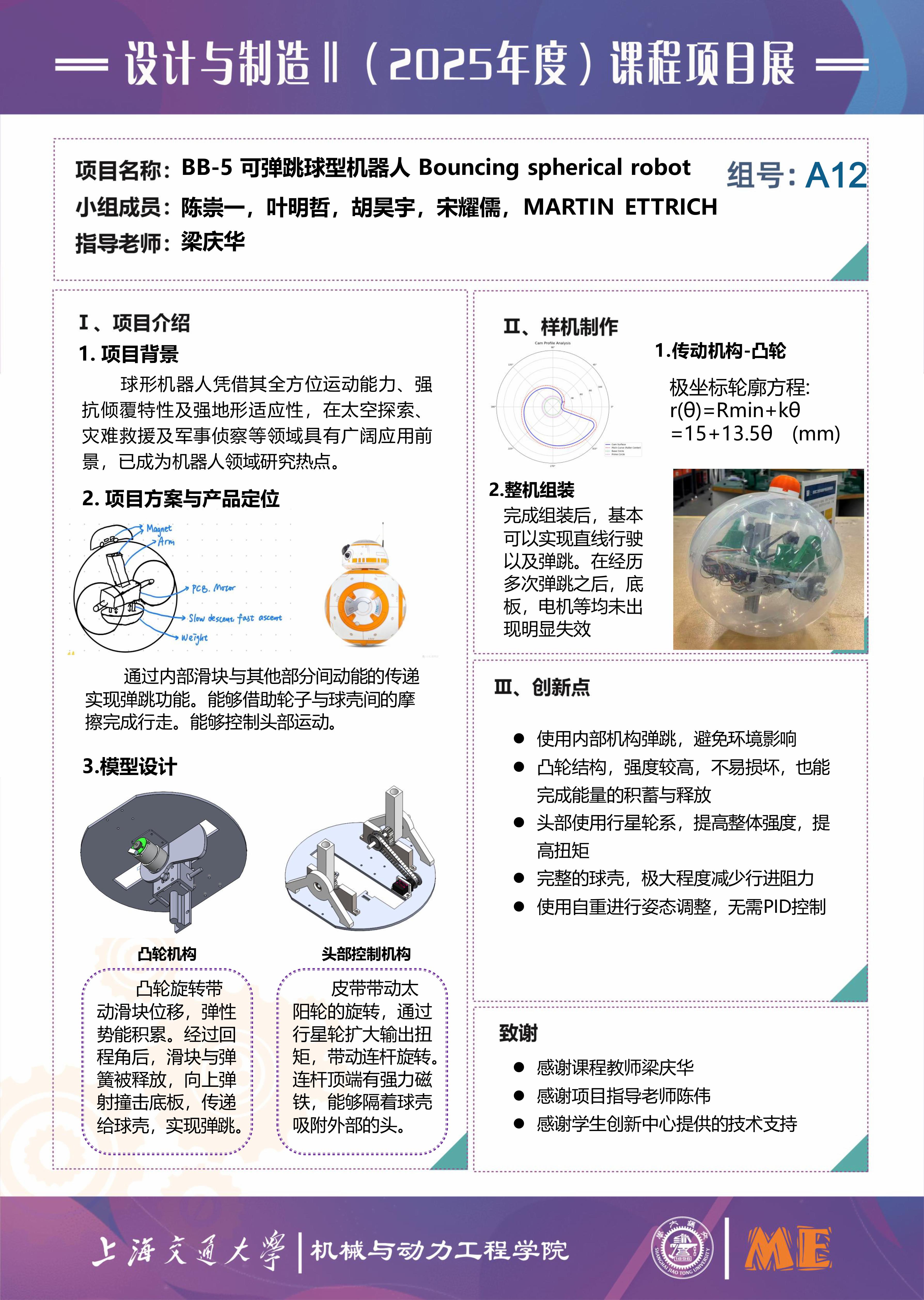
This project designs a spherical robot named BB5 with active jumping capability. To address the difficulty of implementing traditional jumping mechanisms in spherical robots, we employ a cam-slider-spring collaborative energy storage and release system. The mechanism stores energy by using a cam to push a slider and stretch a spring, and releases it to execute the jumping motion. The robot integrates modules such as omnidirectional wheel drive and a planetary gear-based head control system, achieving coordinated jumping, steering, and attitude control within a spherical structure of 300 mm in diameter. The project aims to enhance the mobility of spherical robots in complex terrains, providing new solutions for applications in fields such as exploration and rescue.
The "BB5 Bouncing Spherical Robot" is an innovative robotic system project integrating mechanical design, dynamic analysis, and intelligent control. We have designed a robot platform capable of autonomous bouncing and linear/steering motion within a spherical shell. The robot has a diameter of 300 mm and adopts a modular internal structure, which primarily includes: a cam-driven slider-type jumping mechanism, a planar motion drive system, a head control module using magnetic coupling and planetary gear transmission, and a mechanical platform for overall support and motion coordination.
The core innovation of the robot lies in its jumping mechanism. Moving away from traditional direct-spring approaches, we adopted a collaborative "cam-slider-spring" energy storage and release system. The cam rotates along a specific profile to push a slider, stretching the spring to store energy. When the cam enters the fall phase, the slider is rapidly released, converting the stored elastic potential energy into kinetic energy to propel the entire robot upward. This design not only addresses the challenge of jumping with uncertain ground contact poses in spherical robots but also enables controllable jump height and landing stability.
The head control system employs a servo-driven timing belt and planetary gear mechanism, balancing transmission efficiency with structural compactness and effectively reducing load impact during jumping. This lays a physical foundation for subsequent environmental adaptation and task execution.
Spherical robots hold broad application prospects in fields such as field exploration, disaster rescue, and planetary exploration due to their omnidirectional mobility, strong impact resistance, and terrain adaptability. However, existing spherical robots are mostly limited to rolling motion and lack active obstacle-crossing and jumping capabilities, severely restricting their operational range and functional performance in complex terrains.
Through this project, we aim to overcome the motion limitations of spherical robots by equipping them with active jumping abilities, thereby expanding their application scenarios. For example, in rubble search and rescue, the robot could jump over obstacles or ascend steps; in field inspections, it could navigate trenches and rocky terrain; in interstellar exploration, jumping capability could help traverse small craters or rock barriers.
We have designed a spherical robot that includes mechanisms such as cam, belt, and planetary gears, enabling it to move on a horizontal plane.
The detailed 3D CAD model is constructed using Solidworks software. We utilized technologies such as 3D printing and laser cutting to process some parts. For other parts, such as fasteners, motors, servos, and microcontrollers, we adopted standardized off-the-shelf solutions. We applied much of the knowledge we learned from the lectures to refine the mechanical structure.
The final test results showed that the drive part and the head control part worked well, but due to the excessive weight of the robot itself, the bouncing mechanism could not provide enough force to lift the robot off the ground.
Based on the final test results, despite some issues, our product still achieved the expected functionality. In other aspects, our project still has scope for improvement. For example, a posture sensor and a closed-loop control system can be incorporated to enhance the system's robustness.
